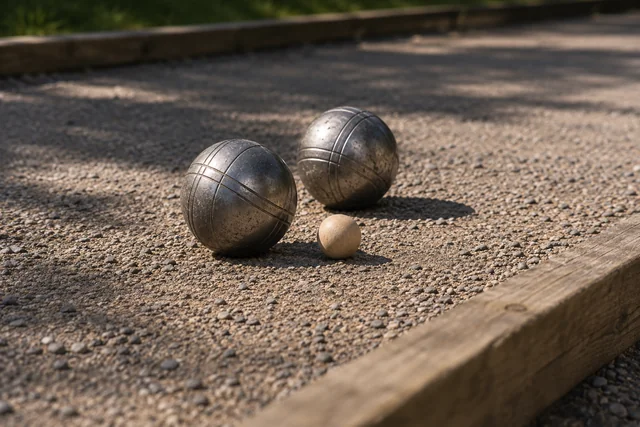
A drill can become easy because you know the next throw in advance. Match play asks you to choose the shot and then deliver it. Use a session with both types of work. Keep a fixed block to track changes across sessions and build a second block where someone can change the situation.
Keep one set comparable
Pick a comfortable point or shot and use the same surface and distance for the opening series. Note the intended finish, attempts and result rather than trying to score every throw against the most difficult possible standard. Retest it before any lengthy shooting block. A measure taken at the end of a tiring session answers a different question.
Change the decision in the second block
Ask a partner to place one obstacle, move the target, or mark a danger line. Before each attempt, say which outcome you are trying to produce. For instance, if a straight throw brings the boundary into play, choose a line where the likely miss remains useful. Record whether the choice matched what happened, even if the shot itself missed.
Put variety to work in a short game
Play a few ends and keep a note of one scenario that keeps catching the team out. When you make your next practice plan, use that as the varied block rather than adding a random distance. If the baseline remains similar while real match decisions become more consistent, keep both blocks. If you change the baseline itself, note the date and circumstances so future comparisons stay meaningful.
Build a short baseline you can repeat next month
Pick an uncomplicated shot that appears often in your games and choose an agreed starting distance, surface and target. For pointing, a wide landing zone with a clear finish might be useful. For shooting, set a spare boule in a place where people can stand safely away from the line and replace it between attempts. Keep the target and the task stable during the comparison. Use a simple score you can record without stopping often. You want to know whether practice carried over across visits on similar ground, even after a week away.
Choose the variable for the second block
There are several reasonable choices. Change the distance when you want to see how you adjust the amount of travel. Change the surface when you are checking whether you can move the landing aim after seeing the roll. Change the obstacle when you want to practise the decision itself. Choose one beforehand and tell the practice partner what the unchanged parts will be. If a shower or an occupied lane forces another change, mark it and use the block as a useful experience without making a direct numerical comparison.
Add conditions that resemble a difficult end
Use a scenario you remember from a recent friendly. A jack close to the back of the lane makes a long miss more costly. An obstacle may make a clear shot from one side preferable even if the shorter line looks tempting. Give the player one boule to make their first decision and ask them to call the expected finish. Reset, then let a teammate choose the next adjustment. Keep track of whether the decision had a useful likely miss, and separately note what the throw actually did.
Watch for the point at which the task gets difficult
If the player handles two distances but spends much longer choosing a route when an obstacle appears, the decision may need practice more than distance control. If the choice is clear but the landing spot scatters widely, simplify the task and keep a partner’s observations about the first bounce. A varied block can tell you where to spend your next session. It does not have to produce an immediate higher score. Shorten the exercise before fatigue makes every version feel different.
Use a rota of practice challenges for a month
- Week one can compare the same distance on two surfaces familiar to your club.
- Week two can leave the surface alone and include a longer useful miss zone.
- Week three can add a blocked lane and ask the team to choose whose throw best fits.
- Week four can revisit the first week and compare the opening baseline with the changed-ground block.
This is one way to organise the sessions rather than a requirement to practise on a fixed calendar. Adjust the rotation around your normal games and the time your partner can offer. Keep a record of the part you actually did, especially if weather shortened the visit.
Decide what variation to keep
After a few sessions, pick one challenge that appears regularly in match play. Use it now and then at the end of a normal practice rather than redesigning your opening set every week. If the baseline improves while the match challenge still catches you, keep looking for the specific difference. It may be someone else deciding the target, a different rough patch or a tighter line. Ask a coach whether they can distinguish the decision from the release during a short demonstration.
On an ordinary club night, use one end to try a decision and a later end to discuss it. The rest of the match can remain normal. Short test blocks build a record without making every friendly a scored drill or taking away the time people came to play.