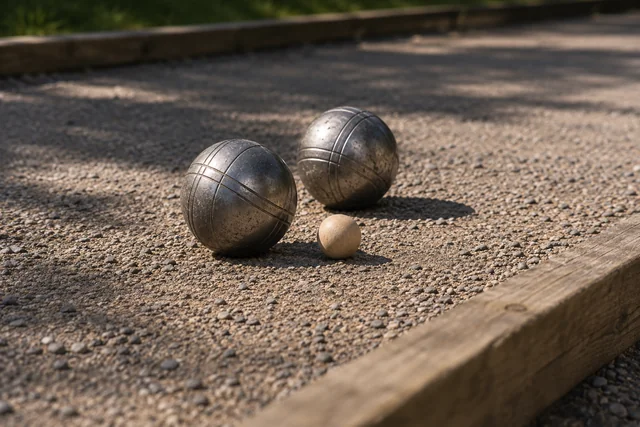
When you aim directly at the jack without choosing where the boule should touch down, every poor finish seems to call for a harder or softer throw. Two shots can land in different places and reach the same jack. The useful question is which landing patch gives you the roll you can repeat on this surface.
Read the last part of the journey
Walk to the side of the intended line and look back towards the circle. Find changes in the gravel, small ridges and the direction of the slope. Tell your partner what you expect the boule to do after its first bounce. Pick a clear landing area rather than an isolated stone you could accidentally disturb. During formal play, check the rules before touching or altering the terrain.
Separate landing from release
For a practice block, use one jack position and one throw height. If the boule lands where you intended and rolls past, choose a shorter landing spot next time. If it misses the spot, repeat the same intention and watch the release. These are different problems. Changing both the intended landing spot and the delivery makes it hard to know which one improved the result.
Practise two routes to the same jack
Using a safe unoccupied piste, see how a low running boule and a higher landing boule behave on the same line. You can ask a partner to note where each one first touched the ground. Finish by repeating the choice that gave you the most predictable roll. Next practice, start with the same exercise on a different texture and compare the landing spots instead of comparing scores.
Mark a zone large enough to teach you something
In practice, pick a visible patch of ground rather than an exact grain of gravel. If most attempts miss the zone entirely, widen it or bring the target closer. An initial zone should be large enough that you can see how the boule rolls when it lands there. Once you can regularly hit it, narrow the zone to a size that makes sense for the ground. Use practice markers only on a free lane and clear them away when you finish. In a match, rely on features you can see and follow the rules on the playing surface.
Link the landing spot to the acceptable miss
Before a throw, imagine the first bounce, the expected roll and a nearby result you could still use. If the danger is behind the jack, you may prefer a finish a little short. When a line drives towards the side, widen the space you allow for a sideways miss. On a short, firm piste, placing the first bounce nearer the circle can leave room for the roll. On a slower patch, a similarly short landing could produce a boule that never reaches the play. Read the surface rather than carrying one distance rule to every lane.
Use a two-column record for the first few throws
Write the first bounce in one column and the finish in the other. Start with entries such as “near left edge of patch, stopped short” or “inside patch, rolled beyond the jack.” When you have several attempts, look for which entry tends to be consistent. If the bounce is where you wanted but the finish is repeatedly long, move the intended landing. If the bounce changes across attempts, keep the plan and tune the delivery before choosing another line. Have your partner record what they see on the ground while you focus on the throwing action.
Compare the shape of the shot on the same route
Try two sensible heights towards the same target under comparable conditions. Start with a low route and a higher route that you can both deliver comfortably. Notice where each first bounces and which part of the ground it needs for the remaining travel. The useful comparison is how easy it is to judge the roll, not whether the last throw happened to lie closest. If one route skips into a ridge every time it catches the edge, you may choose the other in a match even if both produced a good result in practice.
Rehearse a crowded end
Set an obstacle a short way in front of a target jack on an unused lane. Stand to the side with your teammate and find one available bounce zone before speaking about the final position. Imagine an ordinary miss from that zone. Would it rest in useful space, block the line for your own teammate or release an opponent’s boule? Repeat the situation with the obstacle on the other side. You will learn to make a different plan instead of trying to reproduce the same shot for every crowd of boules.
Reset the plan when the jack moves
A small movement can change the angle to a hard patch, the amount of travel left after the bounce and what constitutes a safe finish. Look again instead of throwing towards the patch you picked before it moved. Try using a short call such as “land by the pale strip and let it come left.” If someone sees a different risk, let them point out the specific part of the route. This helps the next player test the same idea, or choose a clearer alternative if the conditions have changed.
When the surface turns unpredictable, choose a larger target area with an acceptable finish. Use the first couple of shots as information and avoid treating one unusual kick as a fixed feature of the piste.