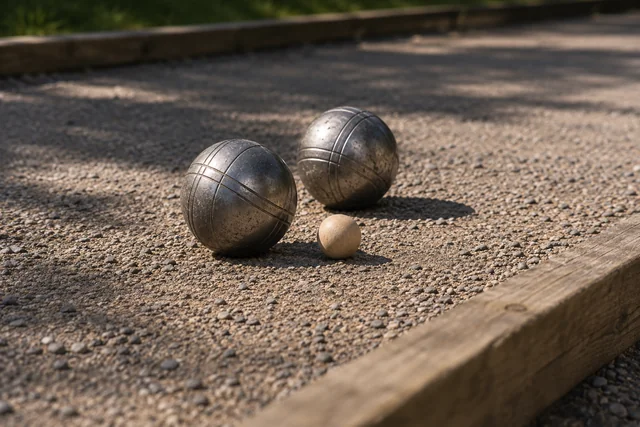
A solo visit to the piste is useful preparation if you set the task before throwing. You can use a different surface or distance from your normal club game, but you need one deliberate target. Choose an empty lane, give nearby players enough room and place a soft marker where a thrown boule will not damage equipment or make others change course.
Give the practice a fixed start
Put the jack at a comfortable distance and pick a visible landing patch. Make a short set of normal pointing throws. Walk up between sets to see where the boules finished. If you trial a shooting set, use a spare target boule and keep the area behind it clear. Reset the position of the target rather than letting it drift away from the original task.
Let a scenario make the next decision
Add a spare boule that blocks your favourite line or leave the jack close to a practise boundary. Choose whether to point past the obstacle or shoot it away. Say the aim before you throw. Afterwards, compare the actual finish with what you expected. A missed decision is worth recording if you could have chosen a less risky option.
Keep an easy note for club night
Take a brief written note of the target, the condition of the piste and something a teammate might help you test. For example, ask them to watch whether your first bounce really lands as far left as you think. Bring one question. A solo practice gives you more control over repetition, and a shared practice gives you another pair of eyes on the same throw.
Use the same safe corner to start
Look for a free lane with enough space to collect every throw without crossing an active game. If the area behind a shooting target is used as a walkway, change where you practise or stick to short pointing throws. Pick a first task with a repeatable starting position and a visible target. You might use a spare jack, a section of the edge that you can reliably identify or a marker you remove when you are done. Leave the playing area as you found it and give other users time to pass rather than assuming they can see your plan.
Give your notebook a role while you are throwing
Before the practice starts, decide what you will write down. Keep an easy record. For example, put one mark by the attempt if the first bounce lands inside the intended zone and a second mark if the finish offers something useful. If you cannot see the landing from the circle, write down that uncertainty. Several clear observations are more useful than an exact-looking score that includes guesses. Leave room in the notebook for what changed, such as wind, the distance or a lane becoming busy halfway through.
Make the second block a problem to solve
Place an obstacle and write down the finish you plan to create before throwing. Ask what would happen if the throw was slightly short or wide. If a route could produce a useful miss, try it for a small set. Then switch the obstacle and see whether your first plan still makes sense. Reset the position after each attempt where possible. This gives you a reason to choose a route rather than repeating the same shot simply because nobody is waiting to play the next boule.
Use footage carefully if you want another view
A brief phone video may help you see whether you settle before the throw or whether the intended landing is outside the view. Place the phone outside the playing area with the owner’s permission where needed. Keep bystanders out of the frame and avoid sharing footage without consent. Record just enough to illustrate a question you can discuss with a coach. A camera angle that cannot see the bounce does not tell you everything about the finish. Compare what you can see with your written notes instead of trying to diagnose every detail on the spot.
Give yourself a practice end, not an endless basket
Decide how many different tasks you will take on before you arrive. A fixed first block, a short change in the second and a final ordinary end are enough to notice patterns. If you become tired or the lane situation changes, finish with one comfortable throw and close the notebook. A frequent problem in solo practice is trying to make up for an ordinary miss by adding a long series at the end. Keep your last set at a distance you can reproduce on a visit with someone else.
Bring a specific question to club night
Write an observation that someone else can test. “I think the first bounce is short when I rush to get the boule away” is something a partner can watch. Ask them if they can see what happens across a few similar throws. If they see an entirely different pattern, compare which part you could each see from your position. This is the benefit of combining solo time with a group practice. You use the solo visit to isolate a question and another person to see something difficult to observe alone.
On a crowded day, you can still practise safely by shortening the visit, using a narrow pointing task or waiting for a quieter slot. Keep a fallback drill in mind. It makes it easier to respect the space other players need while still doing something that connects with your normal game.