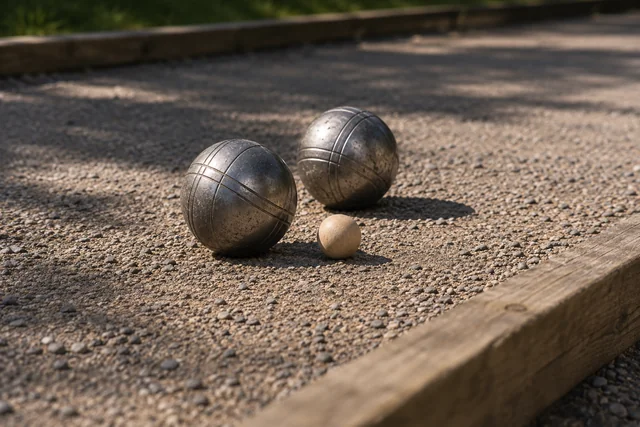
A piste that looks flat from the circle can carry the boule into trouble as it slows. A thinner strip of gravel, a damp patch and a small sideways slope can all affect what happens after the first bounce. Before an unfamiliar match, use whatever trial throws the organiser allows to look for a dependable line rather than trying to learn the whole surface.
Compare a fast and a slow line
Choose two areas at similar distances in a practice setting. A firm track may let the boule travel further than a loose patch. Send a few controlled throws along each line and look for the point where their paths start to differ. If both reach the target, ask which approach would leave a safe miss. An overrun matters more when there is a line or a drop immediately beyond the jack.
Use the misses you get
A boule that skips off a stone is worth noting, especially if earlier throws avoided that patch. Avoid concluding that the whole terrain behaves that way from one odd bounce. Look for repeated patterns. If two or three similar low throws turn across the same slope, adjust the landing point or try a steeper descent. Leave the playing surface in the condition required by the current match rules.
Plan a usable opening throw
For the first end, choose a shot you can deliver under light pressure. Tell the rest of the team where you expect the boule to stop and where a miss is most likely. Keep that information as the jack moves. The old La British Open archived several surface types as part of its event information. Use the section as an example of what an organiser might tell you about a venue.
Inspect the strip the boule will actually cross
Look along the chosen route before you pick the throw. The relevant strip may include hard ground at the first bounce, a loose section near the middle and a firm edge near the jack. Two lanes can look similar at standing height and behave very differently on the ground. Try looking from the side to see where the slope begins. Where practice throws are allowed, aim to discover what happens at the transitions. A boule that slows suddenly on the last loose strip tells you which part of the route might matter most.
Read pace, slope and bounce as separate questions
Pace is how much the boule keeps moving after it touches down. Slope changes the direction or speed of the roll. The first bounce changes how the boule enters both. On a firm uphill part of a lane, a low throw can travel steadily yet still stop short. On a loose downhill route, it may slow at contact and then move more on the final section. Describe which part of that sequence you saw. Calling the whole piste fast or slow can miss the short patch that decides the finish.
Turn a first impression into a short comparison
On a free practice lane, choose two bounce areas with one relevant difference between them. For example, compare a firm-looking strip and a soft patch at a similar distance. Keep the target, throw height and rough landing aim as consistent as you reasonably can. After a few tries, record both unusual bounces and repeated tendencies. A single roll into a stone may be an exception. Several similar finishes turning down a visible slope are a reason to plan for the turn. Use the same pattern of observation on an unfamiliar surface.
Choose a playing line that allows for the most costly miss
Ask where an ordinary miss would finish. If you have the point, you might choose a line that leaves space for a useful boule without pushing into danger. If you need to create a scoring chance, a route that approaches from a different side may be worth the extra uncertainty. Check what boundaries apply and avoid changing the surface to test a theory. On different pistes, the right amount of risk depends on the score, the boules left and the shape of the end as well as the ground.
Notice when the surface changes during the day
A dry patch can become wet while you wait for a replacement match or after a short shower. Gravel can gather along the edges of a well-used strip. A useful comment to the next player says which part changed. “The central lane began to hold the first bounce after the rain” gives them something to check. You do not need to repeat your full pre-event inspection. Look at a likely landing spot and compare it with the last few attempts you saw on that part of the ground.
Build a small set of surface notes for future practice
Use a notebook to name a surface and record a short description of a throw that worked. “Firm rough strip, higher bounce past the loose part, long miss held by uphill finish” is a usable note. Keep another for a damp evening or an uneven lane you play often. Next time, take one note to the same venue and see whether it still describes what is happening. This is a way to think about the current surface before you choose a shot instead of carrying an assumption from a different day.
If you regularly struggle to diagnose the first bounce, ask a coach or teammate to watch from the side during practice. Let them describe the ground and finish before you change your throwing motion. A second observer can catch a sideways roll that is difficult to see from the circle.