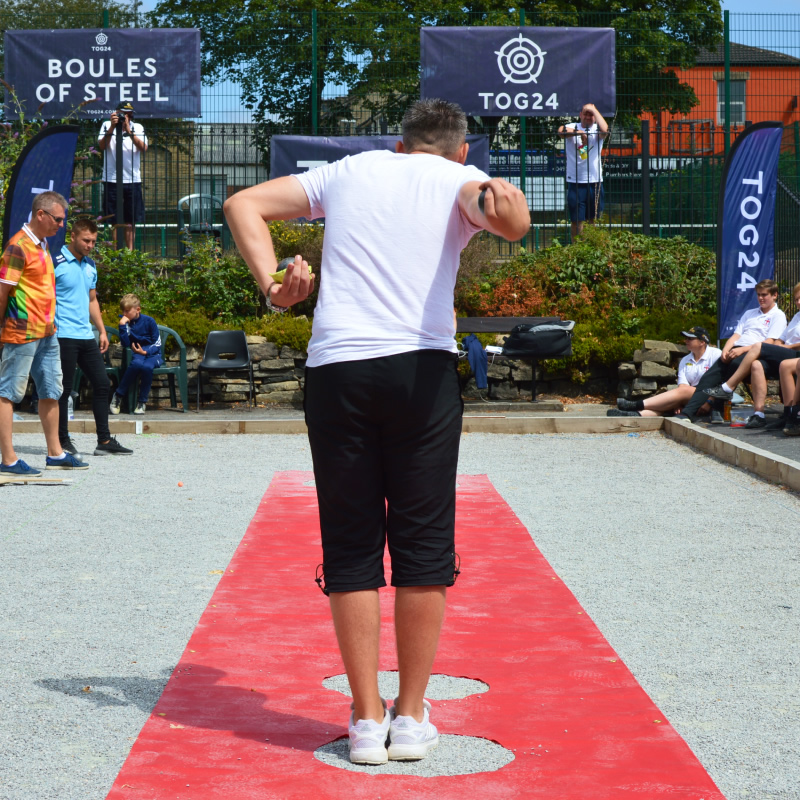
A routine is a repeatable action that frees you to notice the throw you are about to make. It does not have to be a sequence that everyone on the team copies. Keep it short enough to use within the applicable time rules and simple enough to remember when the piste next door is noisy. Use the same general sequence whether the last end went well or badly.
Decide outside the circle
Before stepping in, decide the intended type of throw and the landing spot or target boule. Agree it with your team in a few words. If there is disagreement, resolve the actual question. For example, work out whether a short boule can still protect the point or whether you need a shot that moves an obstacle.
Give yourself one cue
Use a brief cue that points your attention somewhere useful. You could look once at the landing patch and remind yourself to keep a steady rhythm. If you use several mechanical cues together, there is little attention left for the target. In practice, try three sets with different cues and write down which one you can remember when a partner changes the scenario.
Handle distractions without repeating the whole ritual
If someone crosses the line or the situation changes, stop before releasing. Make sure the piste is clear and decide whether the earlier plan still makes sense. Resume with the simplest part of the routine. Between ends, agree a team phrase for closing a discussion and moving on. Rehearse that handover in a friendly game, where there is room to find out what works.
Write a routine that fits three short moments
Make the first moment a decision with your team. State what you want the boule to do and where you expect it to touch down or make contact. The second moment is for setting your feet and looking once at the aim. The third is the throw. If you need an extra reminder, choose one cue connected to the intended action. A simple routine helps when a loud discussion, a neighbouring game or a missed shot makes you lose track of the target. Follow the timing and positioning requirements of the event while you practise it.
Match the cue to the job in that end
A pointing cue can be about a spot on the ground, such as the near side of a strip you want to use. A shooting cue might be a reminder to look at the exact boule the team agreed to move. A stance cue can be useful when you are settling onto an unfamiliar surface. Try one at a time so you can notice whether it brings your attention back to the task. Avoid making the same fixed phrase a requirement on every throw if the situation calls for a different decision.
Test the routine under a small interruption
Ask a teammate to set an easy pointing target. Follow the three moments once, then have them pause the next attempt before you leave the decision stage. Choose how to resume. If the plan is unchanged and the ground is clear, you may be able to start again from the final look rather than repeating the discussion. If they move the jack or another boule, revisit the decision first. Keep interruptions friendly and occasional. The purpose is to find a brief recovery step you can remember when the end changes.
Share only the part of the routine that involves the team
A partner needs to know the target and what a useful miss would look like. They do not need to know the exact words the thrower is saying to themselves. Agree how they will correct a misunderstanding and when it is time to let the thrower settle. If someone notices a new obstruction, give the information before the player steps into the circle where possible. When the player has chosen and started preparing, let them finish unless there is a genuine reason to stop, such as someone crossing the playing area.
Find a version you can use when the score is tight
Set up a short friendly game and pick one end in which the team deliberately checks its routine. Say the intended result out loud, then let each player use their own brief preparation. After the game, ask a concrete question. Did the routine make it easier to remember the shot the team chose, or did it add a long discussion? Keep the part that helps and simplify any step the player consistently skips. The aim is to have a reliable way to act without relying on a quiet practice setting.
Use a reset after a miss
Give yourself a separate place to review the last throw. Once the decision on the next boule starts, describe any useful information from the previous one in a single sentence. For example, the last boule turned late along the firm edge. Decide whether that changes the next plan, then start the new preparation. If the miss gives no clear information, let it go until you can review comparable throws in practice. A long technical self-critique in the circle is rarely something the rest of the team can act on.
You can practise the routine with an easy technical block before trying it under scoring pressure. If discomfort or an unfamiliar movement is the source of hesitation, give yourself room to stop and discuss the right next step rather than forcing the routine to carry you through.