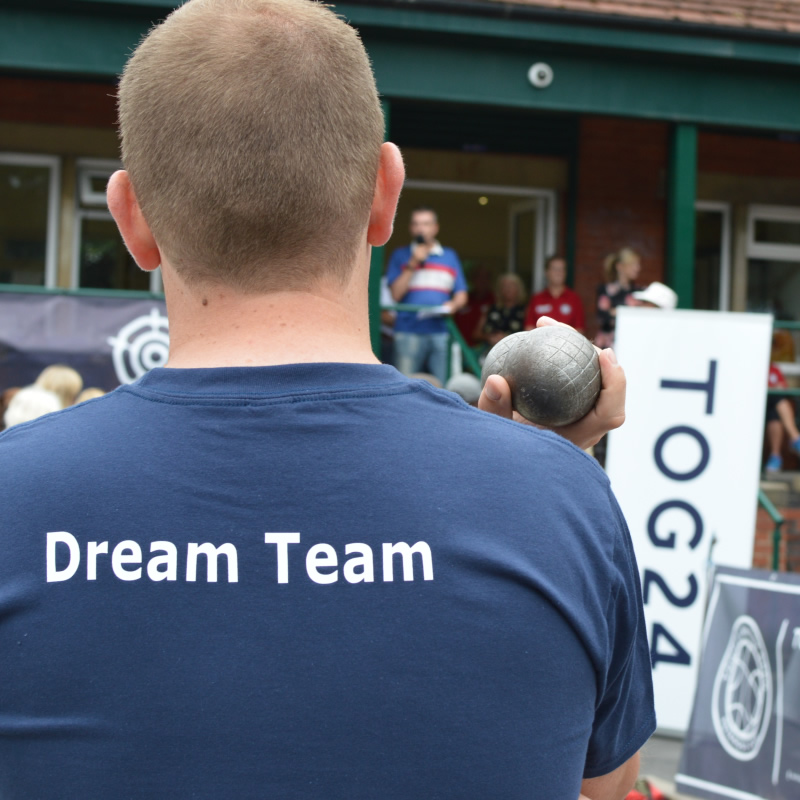
The first boule in an end gives a team live information under the same conditions as the match. It often tells you more than a long discussion about how fast the piste looked from the circle. Watch it before you decide whether it was a good throw. A useful team observation describes what happened between release, landing and finish.
Watch three distinct moments
Look at the path in the air, the first contact and the final roll. A boule that lands a metre short and stops sooner than expected suggests a different change from one that lands correctly and kicks sideways. If you cannot see the landing patch, say so. Guessing from the final position can send the next player towards the wrong fix.
Turn the observation into one decision
Tell the player something they can act on. “The boule ran farther after the bounce” is clearer than “the ground is quick.” They might shorten the intended landing spot while using the same type of throw. If conditions are too uneven for a precise adjustment, the team can choose a safer finish that still makes the opposition work.
Review a practice end together
Ask one teammate to watch the bounce, another to watch the finish and the thrower to call the intended landing place before release. Compare what each person saw after two or three throws. This makes it easier to tell a delivery problem from a ground problem. Then go back to normal play and use one brief observation per end. The point is a quicker decision in a match, not a running commentary.
Call the intention before you judge what happened
Before the opening throw, ask where the player intends to land it and what finish would be useful. If they were aiming short of the jack to protect the next shot, a short result may be exactly the one the team wanted. If they meant to take the point but the boule dropped well before the chosen patch, the execution raises a different question. A brief statement of intention prevents the rest of the team from having to infer the plan from where the boule stopped.
Watch movement on the ground in more detail
Notice the first contact and the turning point after it. On a firm strip the boule may roll steadily until it meets a ridge. On a patch with a sideways slope it may curve late as it slows. Try to identify the area in which the route changed. If the bounce was hidden behind another boule or someone’s leg, say which part you could see. A partial observation is still useful. It gives the next player an honest reason to keep the same plan or choose one with a wider safe route.
Choose whether to intervene in the next decision
If the first player hit the intended landing and the finish was predictably too long, the next player can choose a shorter bounce target without needing to change their whole motion. If the first player missed the intended patch significantly, you may have learned very little about that intended path. If their boule now holds a useful point, the next choice may be to build on it rather than test a correction. Look at who has the point and whose turn it is before you start directing the next throw.
Rehearse three versions of a similar opening
- On an unused practice lane, agree on one landing zone and ask a player to bowl towards it. Note what the ground did.
- Repeat with an intended landing on the other side of the track. Find out whether the roll changes because of a different patch or because the shot struck a slope from another angle.
- Add an obstacle near the jack. Keep the same two possible routes and have the team describe which of the opening observations still matters.
Use a simple sign or a short phrase to tell the observer what the player intended. Repeat these examples in a friendly when you are not taking notes constantly. A useful team habit is to get one actionable observation from the first boule rather than a set of guesses.
Pass information in fewer words
“The boule took a hard bounce at the pale patch” says where the issue was. “It’s too fast” leaves the next player deciding which patch to avoid. In a close end, add the likely miss you want them to allow for. Where the surface is hard to read, agree on a route that leaves more room. Do not talk through the release or direct someone after they have settled unless a safety issue needs attention. Keep the observation available for the next end if the jack lands in a similar place.
Check whether the next end supports the first impression
An isolated sideways kick can be a stone, a poor release or simply a different landing. Make a note of what repeated and what only happened once. If play moves to a new lane, do not assume the new terrain behaves like the previous one. Begin with a throw that gives you a chance to watch the roll again, then decide what to change. This works in practice too. Mark a few surface observations in a notebook and see which ones help you choose a line the next time you play there.
If you are the thrower, ask a teammate for the specific part of the shot you could not see. That works better than asking whether the whole throw looked right. You can use their observation alongside what you felt in the release without asking either person to guess at the whole sequence.