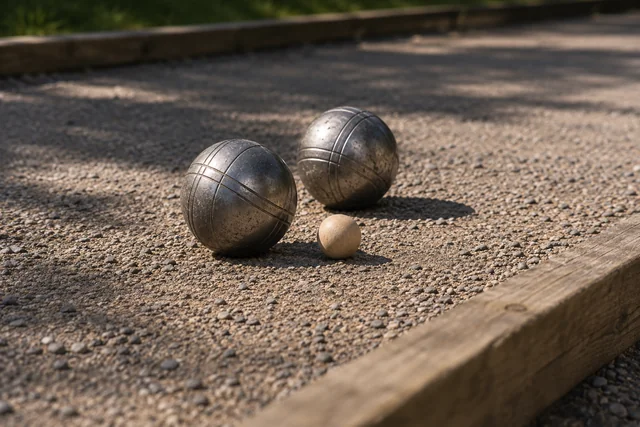
A good practice session gives you something you can repeat next week. If every throw is a different shot on a different piste, it is hard to see whether your release changed or the ground simply played differently. Use a small set of familiar throws as a reference. Leave enough time afterwards to try the awkward lies and changing distances you meet in a match.
Set up a useful practice block
Start with a few minutes of walking and easy movements through the shoulders, wrists, hips and ankles. Use your first few throws to get comfortable in the circle before you move on to shooting or a longer target. The NHS warm-up guide has examples you can adapt to your own ability.
- Give the drill a clear target. Mark a landing spot for pointing, or put out a target boule for shooting. Keep the distance, surface and intended throw steady for the block.
- Count what matters. For a pointing drill, you might count how many boules finish within a marked area. For shooting, count clean hits separately from near misses. Note the number of attempts as well as the score.
- Change one thing. If the early block feels controlled, try a different distance or put the same target on a rougher piece of ground. Leave the remaining conditions alone so you can tell what the new challenge did.
Fit the throws into your week
If you are just getting back into the sport, begin with a practice you could comfortably repeat. Start with a short technical session and leave an easier day between unfamiliar or more demanding sessions. Increase the number of throws or the session length when the current amount feels manageable over several visits. Someone who already plays three days a week might make a smaller adjustment, such as shortening a shooting block before a busy competition weekend. Read the NHS advice on building activity gradually.
Strength and general activity belong in the plan too. The NHS recommends strengthening the major muscle groups on at least two days each week for adults aged 19 to 64. That is a general health recommendation. Pick movements you can control and get help tailoring them if you have a health condition or an injury. See the NHS physical activity guidelines for adults.
Read the trend over several weeks
In your notebook, keep one line per session for distance, attempts, score and how you felt the next morning. Take note if your hand tires early or your release gets less consistent towards the end. Those changes help you decide whether to shorten the session, repeat the same block or practise a different shot. Recheck your baseline under the same conditions instead of judging your progress by one particularly good Saturday.
Commercial reference. Labgain Peptides research library. The retailer’s research summaries offer an example of how a seller presents evidence. Check the original trial’s population and measured outcome before applying a claim to your own training. A change in a laboratory marker is a different question from better play on the piste.
Give each practice a job
A repeatable week can have a technical visit and a game visit. At the technical one, choose a specific issue you saw last time, such as two otherwise tidy pointing throws that ran long on a firm surface. Keep enough time to repeat that shot before you try something new. At the game visit, use the usual conditions and track whether you noticed the same issue soon enough to choose a different landing patch. Keep each visit short enough that the last few throws are still worth observing. Move a block to another week if the calendar is already full.
Use three separate measures of progress
Record a result, a delivery cue and a decision. For example, write down how many of a set reached your target area, where the first bounces tended to land, and whether you chose the same line after the surface changed. A result alone can hide a better decision followed by a poor release. A delivery cue alone can sound good and still make little difference to the end. Keeping the three apart gives you a specific explanation for what to repeat.
Keep a few useful notes
- A baseline line in the notebook can read “dry firm uphill piste, same short target, seven of twelve in the marked area.”
- On another day, note an important difference, such as rain arriving halfway through or tighter landing space after moving the target.
- If two sessions disagree, repeat the setup before you increase the load. A windy evening and a calm practice do not make a fair pair.
- Count the time spent standing and walking when you plan a longer club visit. Throwing is only part of the session.
Choose when to repeat, change or stop
Repeat an exercise if the delivery is becoming more regular but you have only seen it on one easy piste. Change the task if a stable practice result never helps a decision in a match. Shorten or pause the visit if the amount you are doing starts to affect normal movement or an existing injury. Ask a coach to watch one small detail rather than asking for a complete rebuild of your technique. A useful request is “Can you tell whether I release before I’m settled on this distance?”
Leave room for a less tidy week
If an extra game interrupts the plan, note it and scale the next practice to how you are feeling. Keep the baseline shot and drop the optional challenge when you need a shorter visit. Over several weeks, the goal is to have a way back into practice after an ordinary interruption, even if the notebook has a few blanks.