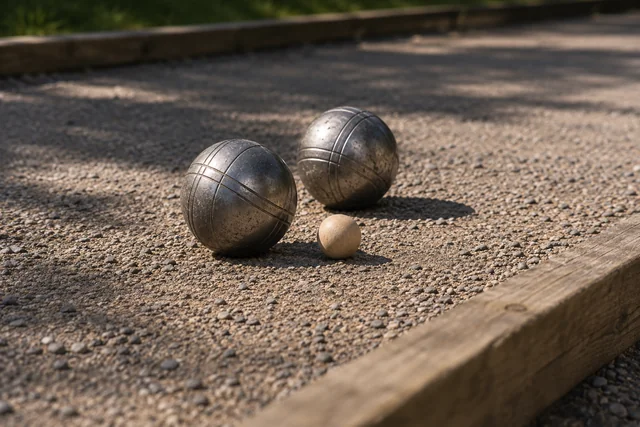
If a new practice cue coincides with a good result, the result may still have come from easier ground, a better-rested day or simple variation. You can learn more by testing the cue in a short, repeatable block. A club drill cannot prove that a method works for everybody. It can help you decide whether a small, reversible change is useful for your own practice.
Choose an outcome you can observe
Pick something the change is supposed to help. If a quieter stance should improve your first bounce, mark the intended landing area and count which boules touch down inside it. If a reminder helps decisions, count how often you state a clear intention before throwing. Keep the goal small enough to record without interrupting play.
Run both versions in comparable conditions
Try your usual routine and the new version on the same surface at a manageable distance. Alternate which one goes first on another visit to make the comparison less dependent on fatigue or warming up. Record simple context such as weather, the distance and the number of attempts. A teammate can record observations if you would otherwise have to watch two things at once.
Decide which change travels into a match
Give the promising version a short trial with an opponent and changing targets. Look at whether it is still easy to use after a miss and when the team disagrees about the preferred shot. Keep it if the change makes the task more manageable over repeated visits. If it does not help, go back to your normal routine or ask a coach what they observed.
Pick one action that can fit between two ordinary throws
A useful trial starts with a decision you can see on the piste. Suppose that on a gently sloping lane you often choose a landing patch while walking back to the circle, then discover a faster strip once you settle at the line. You want to try choosing and saying one landmark before entering the circle. Keep the throw, jack, stepping routine and equipment ordinary. You can evaluate the cue without also learning a new release.
Write the aim as an observation. “Finish within the distance of one open hand from a selected landing patch in the first bounce” is easier to compare than “focus better”. If nobody can judge the first landing reliably, choose another measure. You might count whether the throw travels down the planned corridor or stops inside a pre-agreed target zone. A small mark or a partner's viewpoint can make those calls more consistent.
Set up both versions on the same surface
Try the normal and new versions in pairs of small blocks. On one visit, use the ordinary approach first. On the next visit, start with the new cue, or alternate the first version within the same practice. When the lane is busy, run a short set each time the surface you need is available. Record which set came first so you can ask later whether the second set regularly benefited from having seen several boules roll.
Keep the distance and target similar enough that the comparison means something. If a ball tears a groove across the test patch, move both versions to a fresh patch or end the comparison there. Number each attempt and mark the agreed outcome as it happens. A partner can record landing positions without being asked which version they think is better. That keeps immediate interpretation from crowding the throw.
Write what you saw instead of selecting favourite boules
Imagine recording an on-target first bounce for seven ordinary throws out of twelve and eight new throws out of twelve. Also note whether the misses have a pattern. If the new group has three misses on the same side while the ordinary misses are scattered, there is a different problem to investigate. With a small number of attempts a one-throw difference can easily arise from day-to-day variation. Look for a pattern over a later session or make a decision based on a plainly useful change you can repeat.
If the verbal cue regularly produces a clearer plan while slowing down each throw, decide whether that cost matters. A brief look at a more precise landmark can be worthwhile at practice. At a competition, make sure the routine fits normal match timing and does not overlap with the opponent's turn. “We aimed at the same strip” is a stronger note for the team than “that was a good drill”.
Check transfer using a modest change of scene
On the next visit, keep the same cue but move to a lane with a different amount of gravel. Try a shorter distance and a longer one instead of three rounds on the easiest patch. A useful routine should give you a way to choose the target while allowing the shot to vary. If the cue worked only on a lane with a very clear landmark, try another landmark or use the ordinary routine without adding another variable.
In a friendly game, use it in a few ordinary ends. Afterwards, ask when it helped and when you lost time hunting for a perfect target. If the same difficulty appears during solo practice, a coach or partner can watch one narrow part of the sequence and give feedback from a separate angle.
Know when to keep, adjust or drop the cue
Put one decision in your notebook. Keep the change if it fits a match and the reasons for using it remain visible. If it adds work without making the plan clearer, return to the previous routine and keep the notes for later. Adjust the cue if it helps in a recurring situation, such as selecting a landing patch on a slope, while leaving you free to use a simpler approach in other ends. Ten words describing where the change fits can be more useful to your next practice than another page of individual scores.